Community Safety & Well-Being Plan

Share Community Safety & Well-Being Plan on Facebook Share Community Safety & Well-Being Plan on Twitter Share Community Safety & Well-Being Plan on Linkedin Email Community Safety & Well-Being Plan link

Thank you to everyone who has participated in Phase 1 and Phase 2 of Engagement. Next steps will be shared later this spring.


Review the First Phase Engagement Findings

The first round of engagement was completed in Fall 2025 to better understand community experiences, concerns, and aspirations related to safety and well-being. Six interconnected themes have been identified, which together, describe the key drivers of community safety and well-being challenges in West Kelowna.

At the Jan. 13, 2026 Regular Council Meeting, Council received the Needs Assessment and Engagement Findings Report for information.

To learn more:

How to participate


Working Together for a Safer, Stronger West Kelowna

The City of West Kelowna is developing its first Community Safety & Well-Being Plan. This is a collaborative effort to address the root causes of local challenges and build connected, safe, and strong communities.


What is the Community Safety & Well-Being Plan?

Our Community Safety & Well-Being Plan is a forward-thinking, prevention-focused plan that moves beyond traditional enforcement. It emphasizes prevention, fairness, and overall well-being for all residents. The plan will include both short-term actions that build momentum and longer-term approaches that foster lasting change.


Why it matters

Community safety and well-being are foundational to a thriving city. This plan aims to:

  • Identify key needs: Gain a clear picture of the most pressing safety and well-being challenges in our community.
  • Develop collaborative solutions: Collaborate with local leaders, businesses, partners, and residents to co-create practical and sustainable actions and strategies.
  • Reflect community priorities: Ensure that your insights directly shape the direction and actions in the Community Safety & Well-being Plan.

How your input will be used

The experiences, ideas, and priorities shared through this process will help to directly shape the Community Safety & Well-being Plan. Your feedback will be combined with data, research, and partner input to:

  • Identify community priorities and key areas for action
  • Inform goals and recommendations
  • Guide short-term actions to build momentum and longer-term approaches that foster lasting change

After the engagement process, we will publish a short What We Heard snapshot summarizing constructive ideas, themes, and next steps. These insights will also be reflected in the final Community Safety & Well-Being Plan when it is presented to Council and shared publicly.


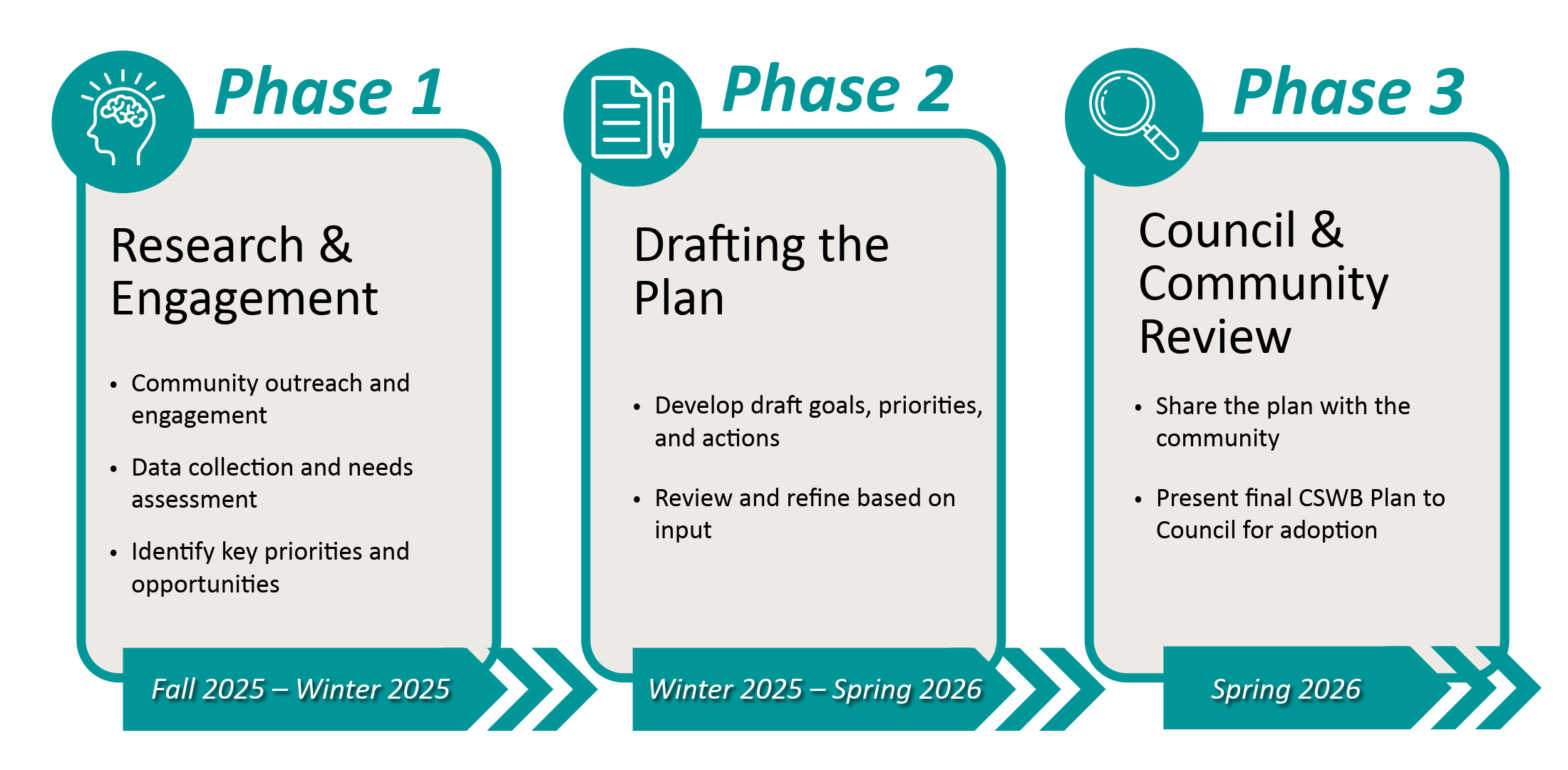
Project timeline

Thank you to everyone who has participated in Phase 1 and Phase 2 of Engagement. Next steps will be shared later this spring.


Review the First Phase Engagement Findings

The first round of engagement was completed in Fall 2025 to better understand community experiences, concerns, and aspirations related to safety and well-being. Six interconnected themes have been identified, which together, describe the key drivers of community safety and well-being challenges in West Kelowna.

At the Jan. 13, 2026 Regular Council Meeting, Council received the Needs Assessment and Engagement Findings Report for information.

To learn more:

How to participate


Working Together for a Safer, Stronger West Kelowna

The City of West Kelowna is developing its first Community Safety & Well-Being Plan. This is a collaborative effort to address the root causes of local challenges and build connected, safe, and strong communities.


What is the Community Safety & Well-Being Plan?

Our Community Safety & Well-Being Plan is a forward-thinking, prevention-focused plan that moves beyond traditional enforcement. It emphasizes prevention, fairness, and overall well-being for all residents. The plan will include both short-term actions that build momentum and longer-term approaches that foster lasting change.


Why it matters

Community safety and well-being are foundational to a thriving city. This plan aims to:

  • Identify key needs: Gain a clear picture of the most pressing safety and well-being challenges in our community.
  • Develop collaborative solutions: Collaborate with local leaders, businesses, partners, and residents to co-create practical and sustainable actions and strategies.
  • Reflect community priorities: Ensure that your insights directly shape the direction and actions in the Community Safety & Well-being Plan.

How your input will be used

The experiences, ideas, and priorities shared through this process will help to directly shape the Community Safety & Well-being Plan. Your feedback will be combined with data, research, and partner input to:

  • Identify community priorities and key areas for action
  • Inform goals and recommendations
  • Guide short-term actions to build momentum and longer-term approaches that foster lasting change

After the engagement process, we will publish a short What We Heard snapshot summarizing constructive ideas, themes, and next steps. These insights will also be reflected in the final Community Safety & Well-Being Plan when it is presented to Council and shared publicly.


Project timeline


Discussions: All (7) Open (0)
  • How to use this forum...

    15 days ago
    Share How to use this forum... on Facebook Share How to use this forum... on Twitter Share How to use this forum... on Linkedin Email How to use this forum... link
    CLOSED: This discussion has concluded.

    You need to be signed in to add your comment.

    In this Forum, you are invited to:

    • Share ideas in response to one question per theme
    • Comment on other people’s ideas
    • Vote on ideas you support
    • Add practical suggestions that improve feasibility
    You do not need to have participated in earlier engagement to contribute.
     
    How to Participate:
    • Read the short summary of what we heard. 
    • Review the “How might we…” question. Post your idea in response. 
    • Comment constructively on other ideas. 
    • Use the thumbs up feature to show support for ideas you believe should be prioritized. 
    Please:
    • Focus on practical, prevention-oriented ideas. 
    • Be respectful and constructive. 
    • Avoid naming individuals. 
    • Keep comments focused on improving community safety and well-being in West Kelowna. 
    All submissions will be reviewed and grouped into common themes. 

    Input will be combined with research, data, and partner insights to: 
    • Identify priority actions Inform goals and recommendations Guide short-term actions that build momentum 
    • Shape longer-term approaches that foster lasting change 
    After engagement closes, these insights will also be reflected in the final Community Safety & Well-Being Plan.
    Replies Closed
  • Theme 1: Housing, Homelessness, and Basic Needs

    15 days ago
    Share Theme 1: Housing, Homelessness, and Basic Needs on Facebook Share Theme 1: Housing, Homelessness, and Basic Needs on Twitter Share Theme 1: Housing, Homelessness, and Basic Needs on Linkedin Email Theme 1: Housing, Homelessness, and Basic Needs link
    CLOSED: This discussion has concluded.

    What We Heard: Housing instability and unmet basic needs are foundational drivers of visible safety pressures in West Kelowna.

    Participants described:

    • A shortage of housing that is truly affordable and matched to people’s needs
    • Hidden homelessness, including couch surfing and precarious living arrangements
    • Growing food insecurity and affordability pressures
    • A lack of daytime spaces, washrooms, and hygiene access
    • A cycle of displacement rather than resolution

    When housing, food, hygiene, and stabilization supports are missing, the impacts show up in public spaces, neighbourhood tensions, and emergency systems.

    How might we strengthen access to stable housing and basic day-to-day supports in West Kelowna so that fewer people enter crisis and public spaces are not the default place to meet basic needs?

    Replies Closed
  • Theme 2: Mental Health, Substance Use, and Health Services

    15 days ago
    Share Theme 2: Mental Health, Substance Use, and Health Services on Facebook Share Theme 2: Mental Health, Substance Use, and Health Services on Twitter Share Theme 2: Mental Health, Substance Use, and Health Services on Linkedin Email Theme 2: Mental Health, Substance Use, and Health Services link
    CLOSED: This discussion has concluded.

    What We Heard: Mental health and substance use needs are increasing, while access to timely local supports remains limited on the Westside.

    Participants described:

    • Long wait times for counselling and psychiatric care

    • Limited youth mental health supports

    • Gaps in detox, treatment, and recovery housing

    • Substance use becoming more visible in public spaces

    • First responders carrying health crises beyond their mandate

    Without coordinated and upstream supports, systems default to crisis response.

    How might we improve access to timely, coordinated mental health and substance use supports on the Westside so that people receive help earlier and crisis response is not the default?


    Replies Closed
  • Theme 3: Community Safety in Public Spaces and Neighbourhoods

    15 days ago
    Share Theme 3: Community Safety in Public Spaces and Neighbourhoods on Facebook Share Theme 3: Community Safety in Public Spaces and Neighbourhoods on Twitter Share Theme 3: Community Safety in Public Spaces and Neighbourhoods on Linkedin Email Theme 3: Community Safety in Public Spaces and Neighbourhoods link
    CLOSED: This discussion has concluded.

    What We Heard: Safety is shaped by everyday experiences in parks, transit areas, Main Street, pathways, and neighbourhoods.

    Participants described:

    • Specific high-use locations feeling unpredictable

    • Lighting and infrastructure gaps influencing perceptions of safety

    • Uncertainty about acceptable behaviour and who to call

    • Public spaces absorbing the impacts of unmet social needs

    Well-designed, active, and welcoming spaces support safety. Infrastructure gaps and unclear expectations increase tension.

    How might we design, activate, and manage public spaces in West Kelowna so they feel predictable, welcoming, and safe for all users?

    Replies Closed
  • Theme 4: Children, Youth, Families, and Seniors

    15 days ago
    Share Theme 4: Children, Youth, Families, and Seniors on Facebook Share Theme 4: Children, Youth, Families, and Seniors on Twitter Share Theme 4: Children, Youth, Families, and Seniors on Linkedin Email Theme 4: Children, Youth, Families, and Seniors link
    CLOSED: This discussion has concluded.

    What We Heard: Prevention gaps across the life course are increasing vulnerability.

    Participants described:

    • Youth lacking safe, welcoming, and low-cost places to gather

    • Transportation barriers limiting access to programs

    • Families accessing support too late

    • Seniors experiencing isolation due to mobility and digital barriers

    Belonging, connection, and early intervention are critical protective factors.

    How might we strengthen early intervention, connection, and accessible community programming for children, youth, families, and seniors before challenges escalate into crisis?

    Replies Closed
  • Theme 5: Equity, Reconciliation, and Belonging

    15 days ago
    Share Theme 5: Equity, Reconciliation, and Belonging on Facebook Share Theme 5: Equity, Reconciliation, and Belonging on Twitter Share Theme 5: Equity, Reconciliation, and Belonging on Linkedin Email Theme 5: Equity, Reconciliation, and Belonging link
    CLOSED: This discussion has concluded.

    What We Heard: Safety and well-being are not experienced equally.

    Participants described:

    • Experiences of racism and discrimination

    • Barriers to culturally safe services

    • The importance of reconciliation-in-action

    • The need for collaboration with Westbank First Nation

    • A desire for services that reflect cultural diversity and lived realities

    Belonging and cultural safety are foundational to a thriving city.

    How might we advance equity, reconciliation, and culturally safe approaches in West Kelowna so that all residents feel respected, included, and supported?

    Replies Closed
  • Theme 6: Systems Coordination, Navigation, and Prevention

    15 days ago
    Share Theme 6: Systems Coordination, Navigation, and Prevention on Facebook Share Theme 6: Systems Coordination, Navigation, and Prevention on Twitter Share Theme 6: Systems Coordination, Navigation, and Prevention on Linkedin Email Theme 6: Systems Coordination, Navigation, and Prevention link
    CLOSED: This discussion has concluded.

    What We Heard: Fragmented systems reinforce crisis response rather than prevention.

    Participants described:

    • Unclear roles across agencies

    • Fragmented outreach

    • Limited shared data

    • Workforce burnout

    • Transportation and digital barriers

    • Difficulty navigating services

    Without coordinated navigation and shared accountability, people fall through gaps.

    How might we improve coordination, navigation, and shared accountability across agencies and systems so that prevention becomes the norm rather than crisis response?

    Replies Closed
Page last updated: 16 Mar 2026, 06:15 PM